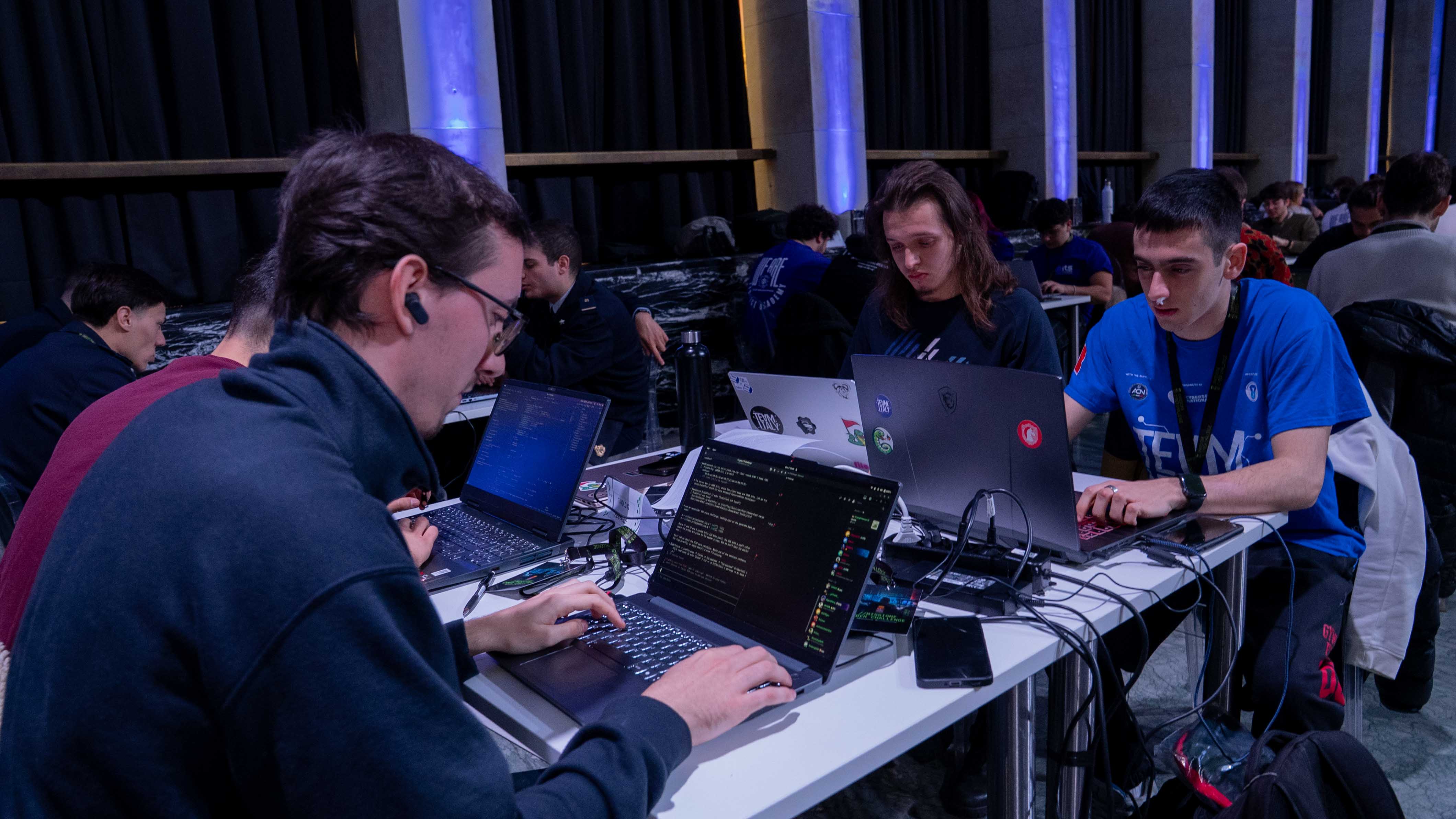
Four members of the ULISSE Students Laboratory, Cristian Di Nicola, Renato Eugenio Maria Marziano, Alan Davide Bovo and Marco Balducci, recently took part in the SMD Cyber Challenge 2025 and secured a remarkable 2nd place finish.
This post brings you an interview with the team members, who share their experiences, strategies, and advices for aspiring cybersecurity enthusiasts.
Question 1. How did you prepare for the SMD Cyber Challenge?
Tell us about your preparation journey: what resources did you use, how much time did you dedicate to training, and how did you coordinate your preparation as a team?
Cristian:
“We focused on tooling and setup. The night before we relaxed in a B&B to avoid morning logistics and pre-configured our laptops with useful tools and AI MCP to support fast problem solving during the ctf.”
Renato:
“I didn’t expect such a fierce competition, so my main focus was on automation of easier challenges. I spent the night before the competition taping together an agent that would auto solve challenges. It turned out to be pretty useless, but it was fun nevertheless.”
Marco:
“To prepare, I mainly continued my usual routine of playing CTFs on weekends. Team organization, however, was new for me: we built custom tools for the competition and divided tasks by category to work more efficiently.”
Question 2. What was the most difficult challenge you faced during the competition?
Among the 18 missions proposed, which one tested you the most and how did you manage to overcome it? Was there a moment when you thought you might not make it?
Cristian:
“The hardest was “Arturo: Echoes of NEOCORP”, it required multiple steps and chained vulnerabilities, but I stuck with it and managed a first blood with 30 minutes left, which was a huge turning point.”
Marco:
“The hardest challenge was the only binary exploitation task. I spent almost the entire competition on it but didn’t finish the exploit in time. Still, it was a valuable experience. Talking to the only team that solved it helped me see alternative strategies and confirmed that my approach was on the right track.”
Alan:
“[…] I faced some difficulties with all the black boxes websites which required me much more time for a complete analysis.”
Question 3. How did you manage teamwork during the competition?
How did you divide tasks among cryptography, OSINT, digital forensics, reverse engineering, and vulnerability analysis? Do you have a particular strategy for collaborating under pressure?
Renato:
“We all know each others strengths in the team, and whenever I was free I would help my teammates with blockers.”
Marco:
“We divided tasks based on our interests and what we usually do in CTFs: I handled pwn, Alan worked on web, Cristian on reverse engineering, and Renato on Web3. For similar categories, the responsible person covered both; for everything else, we assigned tasks to whoever was free.”
Question 4. How did ULISSE contribute to your success?
What role did the laboratory play in your technical training and competition preparation? Are there any tools, courses, or experiences at ULISSE that were particularly useful?
Cristian:
“ULISSE was key for growth! Meeting highly skilled people, becoming friends, and solving/analysing challenges together significantly accelerated my learning and sharpened our preparation.”
Marco:
“The ULISSE course that helped me the most was CyberChallenge training. It improved my understanding of vulnerabilities and allowed me to meet people who are now my regular CTF teammates.”
Alan:
“The ULISSE team […] taught me a lot of new concepts about cybersecurity […] but also made me meet a lot of other young cybersecurity talents such as Renato.”
Question 5. What advice would you give to students who want to approach cybersecurity?
For those just starting out or wanting to participate in similar competitions in the future, what are the first steps to take and what skills do you consider essential to develop?
Cristian:
“Start with solid basics and lots of practice: learn a bit of programming, get confident “hands-on” with a PC, master browser searching and using AI smartly, then grow by grinding lots of challenges on dedicated platforms, because in my view that’s the only real way to improve, and even when you don’t know the solution, pushing yourself to find a path teaches you the most.”
Renato:
“Don’t focus on notions, and always keep your curiosity up. If you fully understand a system, you can hack it, so always ask the whys and what ifs.”
Marco:
“The best way to start is by joining a community that can guide you through the field. That’s how I started, and it made a big difference. Essential skills include curiosity, consistency, and the patience to spend hours on a single problem.”
Alan:
“Start learning with small steps, but spend plenty of time tackling CTF challenges, even if you’re unsure what to do. Wasting a lot of time on a single challenge is one of the best ways to truly understand it and uncover its vulnerabilities.”
Conclusion
We extend our heartfelt congratulations to Cristian, Renato, Alan, and Marco for their outstanding performance at the SMD Cyber Challenge 2025. Their dedication, teamwork, and strategic approach serve as an inspiration to all aspiring cybersecurity enthusiasts. We look forward to seeing their continued success in future competitions!
Join CyberChallenge.IT 2026!
Registration is open for the 10th edition of CyberChallenge.IT, Italy’s premier cybersecurity training program and competition for young talents. If you’re interested in joining a team and embarking on your own cybersecurity journey, don’t hesitate to sign up and be part of this exciting experience!
ULISSE is the University of Bologna’s Laboratory for Information and System Security, dedicated to training the next generation of cybersecurity professionals through hands-on experience and competitive challenges. See here for more information about our mission and activities.
Our CTF team regularly participates in national and international competitions, achieving remarkable results and fostering a vibrant community of cybersecurity enthusiasts. See here for more information about our activities and achievements.